Embedded Systems / Machine Learning
ESP32 Object Recognition
An ESP32-based object recognition prototype that rotates an object in front of a stationary ultrasonic sensor, collecting distance measurements for machine learning classification.
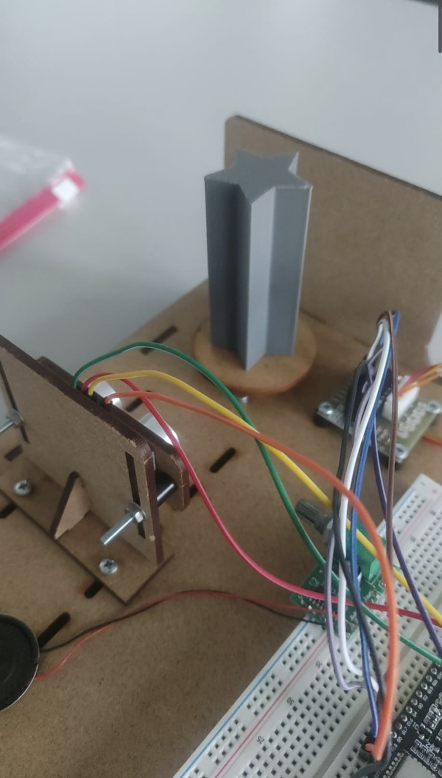
Project Overview
The goal of this project was to connect physical sensing with data-driven object recognition. An ESP32-based prototype collected distance readings while a stepper motor rotated the object in front of a stationary ultrasonic sensor. The measurements formed the basis for a Python data processing and MLP classification workflow.
Hardware & Prototype
The prototype combines an ESP32 microcontroller, an ultrasonic distance sensor, a stepper-driven rotating object platform and a breadboard-based circuit. The platform rotates the object while the ultrasonic sensor remains stationary, allowing distance measurements to be collected at successive angular positions.
Scanning & Data Collection
The stepper motor rotates the object through successive positions while the stationary ultrasonic sensor measures its distance from the object surface. The readings are logged in centimeters and associated with successive rotational positions of the object, creating a structured set of measurements from the physical environment.
Motor & Sensor Control
MicroPython code was developed and tested using Thonny. The captured code shows a four-pin motor stepping sequence, a 200-step-per-revolution setting and ultrasonic trigger/echo connections. This control logic provides the foundation for repeatable scanning.
Data Preprocessing
The collected sensor readings were processed in Python. The workflow included cleaning, normalization and preparation of measurements for machine learning. This stage connects the raw sensor output to the data format required for classification.
MLP-Based Classification
A multilayer perceptron (MLP) model was trained to classify objects using the processed sensor data. The overall workflow links physical measurement, preprocessing and model prediction. Model accuracy and benchmark results are not included here because verified evaluation figures are not available.